Simple example of a hybrid study
This section represents a simple example of a hybrid study that demonstrates how to integrate GEMS models into Antares Simulator. The example can be found in the resources folder and covers a one-week time horizon.
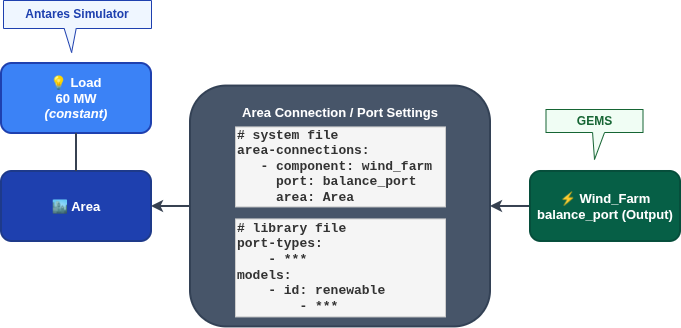
Hybrid Study Example Details
This consists of an area from Solver framework with a constant demand of 60
MW throughout one week and a wind farm component made from the
renewable model from the
basic-models-library (see reference libraries).
Concerning the connection between the area and the renewable component, it's configured by these yaml files:
library:
id: example_library

port-types:
    - id: flow_port
    description: A port that transfers a power flow.
    fields:
        - id: flow_field
    area-connection:
        injection-to-balance: flow_field
        spillage-bound:
        unsupplied-energy-bound:

models:
    - id: renewable
    parameters:
        - id: generation
        time-dependent: true
        scenario-dependent: true
    ports:
        - id: balance_port
        type: flow_port
    port-field-definitions:
        - port: balance_port
        field: flow_field
        definition: generation
system:
id: system

components:
    - id: wind_farm
    model: example_library.renewable
    parameters:
        - id: generation
        time-dependent: true
        scenario-dependent: true
        value: wind

area-connections:
    - component: wind_farm
    port: balance_port
    area: Area
Since the wind farm does not produce enough energy to fully cover the demand, the results include Energy Not Served (ENS).
This example is intended solely to demonstrate how the GEMS component, when connected to an Antares Simulator area, emits a linear expression that is incorporated into the area's balance constraint.
In this specific case, wind generation during the first hour is 20MW and demand is 60MW. As a result, the Antares area reports an ENS of 40MW, which is consistent with the balance shown in the simulation results.